
Thyroid Awareness Month: Understanding Thyroid Health, Testing, and Support
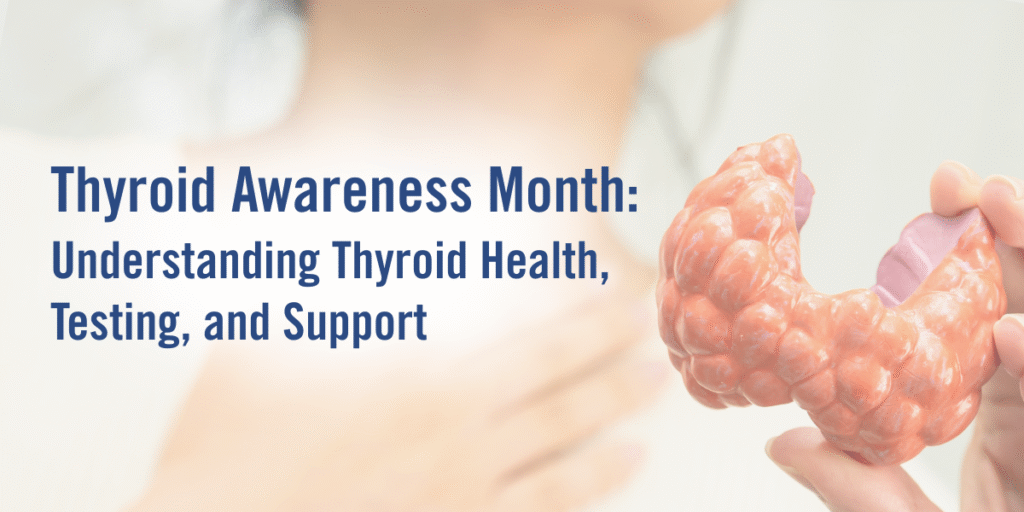
January is Thyroid Awareness Month, an opportunity to increase awareness of thyroid conditions. Up to 20 million Americans may be living with a thyroid condition, many of whom (estimates indicate up to 60% of cases) haven’t been diagnosed. The thyroid gland is located in the neck and produces hormones essential for regulating various bodily functions, such as heart rate, metabolism, body temperature, and protein production. Individuals may have an underactive thyroid (hypothyroidism) or an overactive thyroid (hyperthyroidism), which can lead to health problems, especially if left untreated. Raising awareness empowers individuals to identify symptoms, advocate for necessary testing, and receive the medical care they deserve.
Thyroid Conditions
Data from 2023 show a rise in diagnosed hypothyroidism from 9.5% in 2012 to 11.7% in 2019, the most commonly occurring type of thyroid disease. Hypothyroidism is a condition in which the thyroid gland does not produce enough thyroid hormones to support the body’s metabolic needs. A diagnosis is determined by drawing a thyroid lab panel to assess for abnormal values. It is also possible for someone’s labs to fall within the standard reference range, but still experience symptoms of hypothyroidism. This may also occur in cases of subclinical hypothyroidism, where the thyroid-stimulating hormone (TSH) value is slightly elevated, but other thyroid labs remain within the normal range.
So, what does all this mean? Thyroid-stimulating hormone (TSH) is a hormone produced by the pituitary gland that stimulates the thyroid gland to produce thyroid hormones, which regulate metabolism. If TSH levels are high, it indicates the body is trying to stimulate the thyroid gland, but the signal isn’t being received and relayed as intended. If TSH levels are low, this can suggest that the thyroid is producing too much hormone, referred to as an overactive thyroid (hyperthyroidism). The pituitary gland reduces TSH because there is already too much thyroid hormone in the body.
The role of TSH is to tell the thyroid gland to produce hormones thyroxine (T4) and triiodothyronine (T3). Iodine is an essential mineral for thyroid health, as the thyroid gland uses it to produce thyroid hormones. The thyroid naturally produces more of an inactive T4 hormone, which is then converted into the active T3 hormone in other parts of the body, such as the liver, kidneys, and muscles. This is why having at least these 3 values measured is essential, and why the impact on the body is far beyond the thyroid gland itself.
Autoimmune Thyroid Conditions
Within these conditions are additional classifications of autoimmune hypo- and hyperthyroidism. An autoimmune condition occurs when the immune system attacks another system or part of the body, in this case, the thyroid gland. Hashimoto’s thyroiditis is an autoimmune hypothyroid condition. It has been estimated that over 80% of individuals with hypothyroidism will at some point be diagnosed with Hashimoto’s thyroiditis. Diagnosis often includes hypothyroid symptoms and lab testing, with the addition of elevated thyroid peroxidase antibodies (TPO antibodies, also called TPOAb). The presence of these antibodies (proteins) indicates that the immune system is mistakenly working to attack the thyroid gland’s thyroid peroxidase enzyme. TPO is a critical enzyme that uses iodine to help make thyroid hormones.
Graves’ disease is an autoimmune hyperthyroid condition where the thyroid gland is overactive, and the immune system mistakenly attacks the thyroid gland. This thyroid condition has more advanced testing options for diagnosis, including the blood test TRAb (thyrotropin receptor antibody) as well as a radioactive iodine uptake test and ultrasounds. Approximately 60-80% of hyperthyroidism is due to Graves’ disease.
In either case, the exact cause of the immune system attacking the thyroid gland is unknown, but genetic and environmental factors are believed to play a role. Diagnosis and treatment of autoimmune thyroid conditions may be similar or different from non-autoimmune thyroid conditions. For additional resources, see the American Thyroid Association website.
Risk factors
Who is at risk of developing a thyroid condition? Rates are highest among females, individuals with a family history of thyroid disease, those with other autoimmune conditions, and individuals over age 60. There is also a greater risk of developing thyroid dysfunction during life stages when other hormone levels fluctuate, such as during pregnancy, postpartum, and perimenopause.
Environmental risk factors may also negatively impact thyroid health, including endocrine-disrupting chemicals (EDCs), inflammation, and stress. EDCs are commonly found in personal care products, pesticides, certain plastics (BPA), and flame retardants. These chemicals have the potential to interfere with the thyroid pathways in the body and contribute to the autoimmune thyroid processes.
While the pathways by which stress and inflammation impact thyroid function are less clear, the increased demand these put on the body has been shown to contribute to changes in thyroid function.
Symptoms and testing
Symptoms of hypothyroidism include, but are not limited to, fatigue, brain fog, frequently feeling cold, slow heart rate, low mood/mood swings, difficulty losing weight/weight gain, constipation, irregular menstrual cycles, dry skin, dry hair, thinning hair, and joint and muscle pain.
Symptoms of hyperthyroidism include anxiety, weight loss, rapid heartbeat, frequent bowel movements, trouble sleeping, heat intolerance, and an enlarged thyroid.
A goiter is an enlargement of the thyroid gland that may be due to swelling or may be made up of one or more lumps or nodules within the gland. It can be caused by iodine deficiency, nodules, or conditions like Graves’ disease and Hashimoto’s. It is often painless but can cause difficulty swallowing and breathing, voice hoarseness, and a feeling of tightness in the throat. In the United States, the prevalence of goiter is about 5%, which is relatively common.
Treatment options and medication management
Treatment of hypothyroidism typically involves medication and lifestyle considerations. There are different approaches to medication management, including the most common approach, a thyroid hormone replacement (such as Levothyroxine) that is biologically equivalent to T4, or desiccated thyroid extract derived from pigs and cows (such as Armour and NP Thyroid), which contains varying amounts of T3 and T4 hormone. It’s important to maintain consistency with the type of medication that is chosen, including sticking with the same brands versus switching to a generic. If a change is required or happens because of insurance coverage, a patient should notify their doctor.
Treatment options for hyperthyroidism include antithyroid medications, radioiodine, or possibly surgery to remove the thyroid gland.
While on thyroid medication, regular monitoring of lab values is key to ensure dosing is adequate (even if symptoms have been resolved), since the thyroid impacts other aspects of total body health.
When adding thyroid medication to your daily routine, there are specific considerations for timing to minimize barriers to absorption. It’s best to take medication at the same time every day. Either first thing in the morning on an empty stomach, 30-60 minutes before food or caffeinated drinks, or 3-4 hours after your last meal or snack of the day. Food and supplements can interfere with the absorption of thyroid medications and should thus be taken separately, including soy and some cholesterol-lowering medications. Iron, calcium, multivitamins, and certain antacids should not be taken within 4 hours of thyroid medication. Biotin supplements may impact thyroid lab results, so it’s advised to stop taking supplements containing biotin (such as a multivitamin or hair-skin-nail supplement) 2-3 days before lab testing. Several medications may require someone to need a different thyroid medication dosage, so any changes to existing medications or the addition of a new medication must be discussed with a physician.
Nutrition and Lifestyle Management
While medication is a first step for many, key nutrients must be considered for optimizing thyroid health and functioning. Selenium is a mineral needed in the formation of hormones and protects the thyroid gland from oxidative damage. Low selenium levels have been linked to Hashimoto’s, higher levels of inflammation, and thyroid antibodies. Zinc is a mineral required for the conversion of inactive T4 to its active form, T3, and for the appropriate functioning of the T3 receptor. Low zinc levels increase the risk of hypothyroidism and may be associated with thyroid autoimmunity. Similarly, magnesium is essential for the conversion of T4 into active T3. Magnesium also plays a role in iodine uptake. As mentioned earlier, iodine is needed by the thyroid gland to synthesize T4 and T3.
The best approach to optimizing nutrient status is a balanced, varied diet. Key sources of selenium include Brazil nuts, fish and seafood, meat and poultry, and eggs. Top sources of zinc include shellfish, meat and poultry, legumes, nuts, and seeds, and some dairy products. Magnesium-rich foods include leafy green vegetables, nuts and seeds, whole grains, fatty fish, beans, and legumes. Iodine is found in dairy products, eggs, fish, seafood, seaweed, and iodized salt.
No nutrients occur in isolation, so these foods are also rich in other essential nutrients such as iron, vitamin A, vitamin D, omega-3s, protein, and B vitamins. While dietary supplements may help fill gaps, it’s not recommended to supplement with high doses or without the guidance of a health care provider, especially while taking thyroid medication. For individuals managing an autoimmune thyroid condition, additional planning related to diet and supplementation may be beneficial.
How a dietitian can help
At Summerfield, we support many patients in managing thyroid conditions. We discuss dietary recommendations that are both essential to thyroid health and customized to the individual. Some patients benefit from focusing on anti-inflammatory foods; others from a Mediterranean Diet approach; still others from reducing gluten, grains, and/or dairy, or from a more advanced autoimmune diet. The most important aspect is finding an eating approach that is enjoyable and sustainable.
In addition to nutrition, supportive practices such as adequate sleep, stress management, and regular physical activity are essential to optimal thyroid function and overall health.
If you are managing a new or existing diagnosis or would like more support navigating your thyroid health, contact us today!
